
Mold remediation in Nashville, TN
Mold remediation in Nashville is a moisture job first: a crawl space that stays damp all summer, a slow leak behind a wall, or flood water that soaked the framing. The work seals off the area, removes what can't be cleaned, cleans and dries the rest, then fixes the source. Tennessee licenses mold remediation as its own contractor class.
Your call is connected with an independent local company that serves Nashville. Water category: depends on the water behind it; mold that grew after sewage or flood water starts as Category 3.
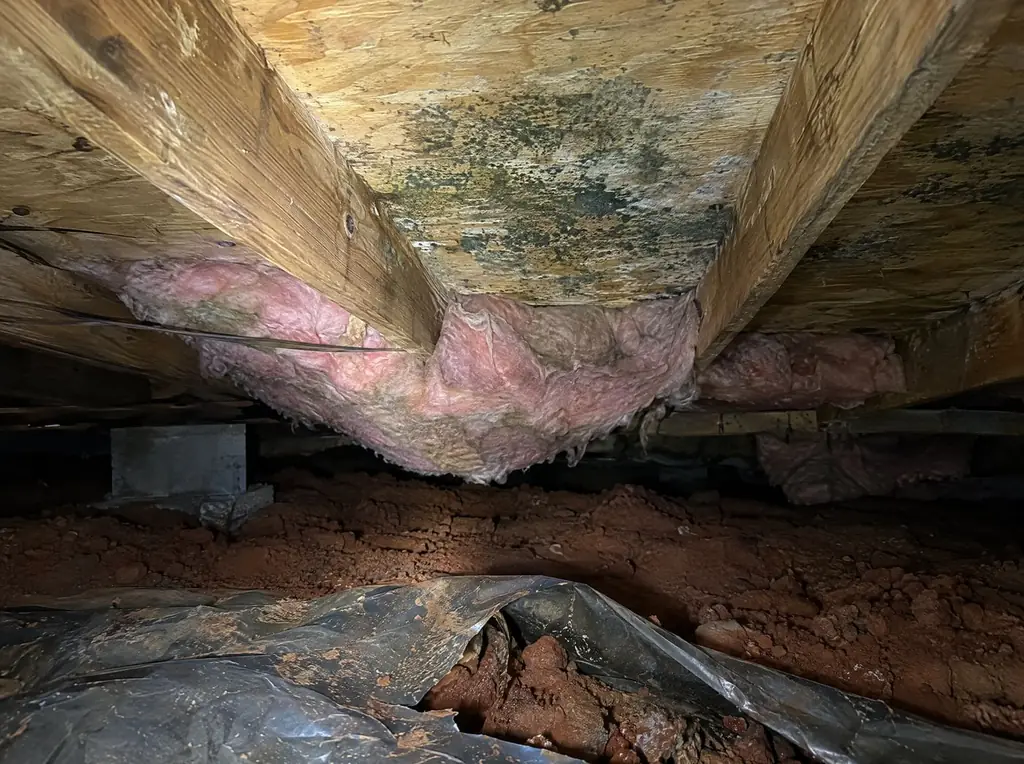
Check the places nobody sees: the crawl space under a 1950s or 1960s house, the wall behind a dishwasher or washer, and the bottom few inches of drywall in any room that took on water in a storm. The patch you can see is usually smaller than what sits behind it.
Right now
- 1Find and stop the water: close a supply valve, put a pan under a drip, or pump out standing water under the house if it is safe to reach.
- 2Don't scrub or dry-brush a large patch; that sends spores into the rest of the house.
- 3If mold may be near the furnace, the air handler or the ducts, keep the system fan off until someone checks it.
- 4Before anything is moved, take dated photos and a short video for your own records.
- 5Run the air conditioning or a dehumidifier in the rest of the house to bring indoor humidity below 60 percent.
Nashville facts for this problem
Tennessee's Board for Licensing Contractors lists mold remediation as a specialty classification of its own, S-F Mold Remediation.
Source: Tennessee contractor board, license classification outline (lists S-F Mold Remediation).
Davidson County is one of nine Tennessee counties where residential remodeling and repair from $3,000 to $24,999 needs a state home improvement license.
A Tennessee home improvement license requires a $10,000 surety bond plus general liability and workers' compensation insurance.
Tennessee's insurance department lists flood damage and water from backed-up drains or sewers among losses a standard homeowners policy typically doesn't cover.
Source: Tennessee Department of Commerce and Insurance: Disasters.
The EPA asks homeowners to keep indoor relative humidity below 60 percent, and ideally between 30 and 50 percent.
A normal Nashville year brings 50.51 in. of rain in the official record, and May is the wettest month at 5.02 in. (1991-2020 normals).
Source: ACIS daily record, Nashville area climate record, calculated by Nashville Water Damage & Mold on November 18, 2026.
Census estimates for ACS 5-year 2020-2024 put about 44% of the homes in the 16 Nashville ZIP codes that lie mostly in Metro's general area as built before 1980.
Source: U.S. Census Bureau, ACS 5-year, tables B25034 and B25035, calculated by Nashville Water Damage & Mold on November 14, 2026.
Tennessee's contractor board lists mold remediation as its own specialty classification, S-F. Davidson County is one of nine counties where a residential job from $3,000 to $24,999 needs a home improvement license, which requires a $10,000 bond plus liability and workers' compensation coverage. The state's Verify a License page shows who holds what.
Sources: Tennessee contractor board, license classification outline (lists S-F Mold Remediation); Tennessee Board for Licensing Contractors: Home Improvement Contractor (Davidson County, $3,000 to $24,999); Tennessee Board for Licensing Contractors: Verify a License
Related on this site: the Nashville rain totals and humidity page for today's humidity and dew point at the airport, and the Nashville flood risk by ZIP for the median year built in each Nashville ZIP.
How the work usually goes
Inspection and moisture source
The company traces the moisture behind the mold, maps how far it reaches with a moisture meter, and writes up what has to come out.
Your part: Ask which Tennessee license the company holds, then check the number on the state's Verify a License page.
Containment
Plastic sheeting closes off the work area and a HEPA air scrubber keeps loose spores from drifting through the house.
Your part: Keep children, pets and anyone with asthma away from the sealed area.
Removal and cleaning
Moldy drywall, insulation and carpet pad usually come out. Framing, joists and subfloor are cleaned and HEPA-vacuumed rather than replaced when they are sound.
Your part: Ask for a written list of what will be removed and why.
Drying and the cause
The leak, the drainage problem or the open crawl space that fed the mold is dealt with, and the area dries until readings are back to normal.
Your part: Keep the moisture readings from each visit.
Final check
A check after cleanup should show the mold is gone and the materials are dry before anything is closed up.
Your part: Ask for the final readings and photos in writing, and keep them with your house papers.
How insurance usually treats it
Tennessee's insurance department lists flood damage and water that backs up through drains or sewers among the things a standard home policy typically leaves out, and mold that follows those losses usually falls with them. Mold after a sudden leak is handled under the policy's own mold and water wording, so read that section or ask the agent what it says.
This explains coverage in general and isn't insurance advice; your own policy has the final word. More on the Nashville water damage insurance page.
What changes the size of the job
- How many square feet are affected, counting what is hidden under floors and behind walls
- Whether the crawl space, the attic or the heating and cooling system is involved
- Containment and air scrubbers to keep spores out of the rest of the house
- How much insulation, drywall or subfloor has to be replaced afterward, which is often a separate estimate
- Whether the moisture source needs a plumber, a drainage fix or a vapor barrier first
No prices on this site. A company measures moisture on site and writes an itemized estimate; the water damage estimator lists what that estimate should include.
Questions people ask about mold remediation
Does Tennessee license mold remediation in Nashville?
Tennessee's Board for Licensing Contractors lists mold remediation as a specialty classification, S-F. Separately, a residential repair job of $3,000 to $24,999 in Davidson County needs a home improvement license, and a project of $25,000 or more needs a contractor's license. The board's Verify a License page shows what a company holds.
How much mold can I clean up myself?
The EPA says a homeowner can usually handle a patch under about 10 square feet, roughly 3 feet by 3 feet. For more than that, after heavy water damage, or where sewage or flood water was involved, it points to an experienced professional.
Why does my Nashville house smell musty after a wet spring?
A musty smell usually means damp materials somewhere, often in the crawl space after a long rainy stretch. The EPA's target is indoor humidity under 60 percent; a hygrometer in the room near the smell shows whether the air is the problem.
How soon can mold grow after a Nashville leak?
Drying wet materials within 24 to 48 hours keeps mold from taking hold, the EPA says. The estimator on this site counts the hours since the water started against that window.
Sources for this page
- Tennessee contractor board, license classification outline (lists S-F Mold Remediation)
- Tennessee Board for Licensing Contractors: Home Improvement Contractor
- Tennessee Board for Licensing Contractors: Verify a License
- Tennessee Department of Commerce and Insurance: Disasters (what home policies typically leave out)
- The EPA's brief guide to mold and moisture at home
- EPA: Mold Cleanup in Your Home